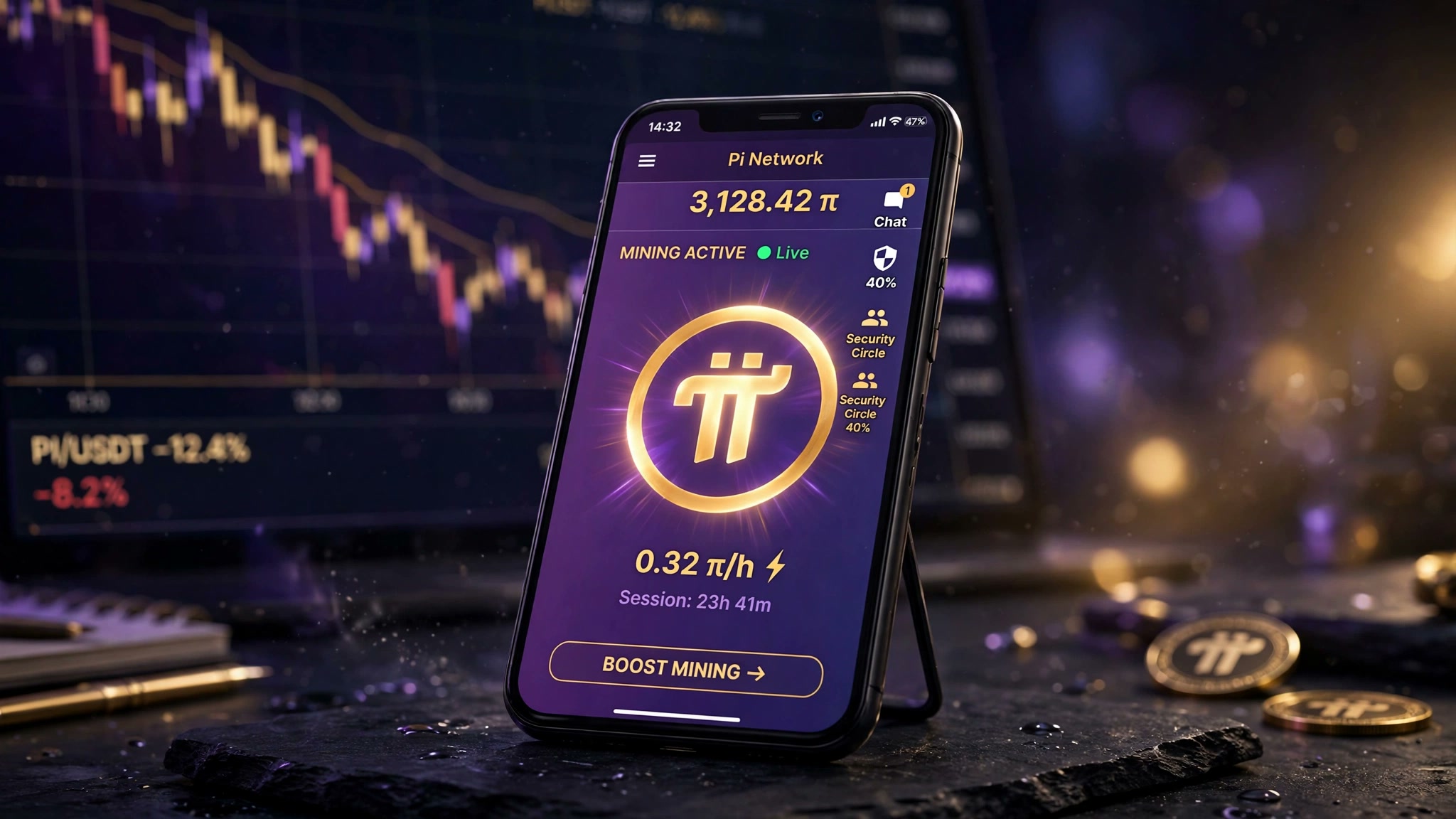
Pi Network printed a fresh all-time low on Friday, November 20, and the number tells the whole story in one line. PI changed hands at $0.0506, the lowest price it has ever traded at, and down 98% from the $2.99 peak it set in February 2025, nine months after its mainnet launch. A coin that tens of millions of people mined on their phones now trades like a project the market has already written off, and the question for anyone still holding it is not whether the forecasts are optimistic. It is whether any of them are still possible.
The published forecasts for 2030 spread from about $0.04 to $22, a range so wide it is useless on its own. Some of the most-cited numbers in that range were written when PI traded five or six times higher, and nobody has gone back to fix them. This guide works through the numbers properly, starting with where PI stands today, then what the project actually is, why it fell so far, and what the forecasters say once the stale models are stripped out.
Pi Network price today
PI trades at about $0.0514 at the time of writing, down 10.2% on the day and 27.7% over the past week. The market value is roughly $585 million, which puts the coin 91st among all cryptocurrencies, and the day’s low of $0.0506 is a new all-time low, set this morning.
| Measure | November 20, 2026 level |
|---|---|
| Price | About $0.0514, down 10.2% on the day |
| All-time low | $0.0506, set today |
| All-time high | $2.99, February 26, 2025 |
| Down from the high | About 98% |
| Market value | About $585 million, ranked 91st |
| Circulating supply | About 11.40 billion PI |
| Total supply | About 17.54 billion PI |
| Maximum supply | 100 billion PI |
| Change over 7 days | Down 27.7% |
What Pi Network actually is
Pi Network started in 2019, built by a team out of Stanford, with an idea that sounded almost too simple to work: let people mine cryptocurrency on their phones by tapping a button once a day. No expensive hardware, no electricity bills, no technical knowledge. The pitch was that crypto had become a game for miners with warehouses full of machines, and Pi would hand it back to ordinary people. Millions of people signed up, and by the time the network finally opened its mainnet in February 2025, the project counted its community in the tens of millions, with roughly 100 million verified users cited in coverage of the launch.
Underneath the phone app, Pi runs on a consensus design borrowed from Stellar, which means transactions settle through trusted validator nodes rather than through mining in the Bitcoin sense. The phone tapping was never really mining. It was a distribution mechanism, a way of handing out tokens to people who showed up every day, with the rate falling as more people joined. The real test was always what would happen when those tokens could finally be sold, and the answer arrived quickly: the price spiked to $2.99 within days of the mainnet launch, then started falling, and it has not stopped since. The project counts roughly 100 million verified users, a figure it promotes heavily, and that community is the asset the forecasts keep coming back to.
That is the context the forecasts have to be read against. Pi is not a coin with a small community and a big idea. It is a coin with an enormous community and a thin market, and the gap between those two facts explains almost everything about the price.
How a $3 coin became a five-cent coin
The fall did not happen in one crash. It happened in a slow grind, punctuated by unlocks. Pi’s supply was designed to unlock gradually, and the schedule has been relentless: more than 1.2 billion PI was set to unlock across 2026 alone, with over 200 million tokens unlocking in February and another 1.3 billion due over the twelve months from that point. Every unlock puts fresh supply into the hands of people who mined it for free, and a large share of them sell. When demand is thin, that is enough to keep the price falling for months.
Demand has stayed thin for a structural reason. PI is not listed on Binance, Coinbase or Kraken, the venues where most new buyers would find it. It trades on a handful of mid-tier offshore exchanges, and that limits who can buy it and how much liquidity is available when sellers arrive. A coin that tens of millions of people hold but few new buyers can easily reach is a coin with a supply problem and a demand problem at the same time.
The migration backlog makes it worse. Mined balances move to the mainnet only after users complete identity checks and migration steps, and millions of balances are still waiting. Every completed migration is another holder who can sell, and the market knows it.
Then came November. Bitcoin fell below $62,000, its lowest since July, as spot ETFs lost $582 million in a day, and the whole market slid with it. PI, with no institutional buyers and no listing to cushion it, fell harder than most, down 27.7% in a week, and printed its all-time low on a Friday morning when the wider market was already in extreme fear. The November slide is not the cause of PI’s problems, but it stripped away the last support and exposed how little demand is underneath.
The $1 question, done with arithmetic
The question every Pi holder asks is whether the coin can reach $1, and it deserves a straight answer with the maths attached, because the answer depends entirely on which supply figure you use.
| If $1 is measured against | Supply | Market value at $1 | Gain needed from $0.0514 |
|---|---|---|---|
| Circulating supply today | About 11.40 billion PI | About $11.4 billion | About 1,846% |
| Total supply today | About 17.54 billion PI | About $17.5 billion | About 1,846% |
| Maximum supply | 100 billion PI | $100 billion | About 1,846% |
The price gain is the same in every row, about 1,846%, because the price is the price. What changes is what the market would have to believe to pay it. At today’s circulating supply, $1 means a market value of about $11.4 billion, roughly the size of a top-15 cryptocurrency today. At the maximum supply of 100 billion PI, $1 means a $100 billion market value, roughly the size of a top-five coin. The supply will keep growing toward that maximum for years, so the honest way to read the $1 question is that PI has to become a top-15 coin at today’s supply, and stay one as the supply grows, just to hold a dollar.
That is not impossible, but it is a much bigger ask than the round number suggests, and it is why the forecasts that put PI at several dollars by 2030 need to be read with the supply figures beside them. A forecast of $5 in 2030 means a market value of about $57 billion at today’s circulating supply, and far more if the supply keeps growing. A forecast of $0.10 means about $1.1 billion, roughly double today’s level. The two numbers sound close on a chart. They describe completely different worlds.
What the forecasters actually say for 2030
The published forecasts for PI in 2030 disagree by more than almost any other large coin, and the disagreement is itself useful information. The table below collects the forecasts that matter, with the date each one was made, because a model written in February does not describe the coin trading in November.
| Forecaster | 2030 view | What it assumes |
|---|---|---|
| CoinStats, November 2026 | Average about $0.095, range $0.040 to $0.200 | Scenario ranges from market-cap arithmetic; ecosystem adoption at the high end |
| DappRadar, November 2026 | About $0.0429 | Algorithmic trend model; slow drift lower from current levels |
| BlockchainReporter, November 15, 2026 | Central range about $0.078 to $0.131 | CoinCodex, CoinCheckup, CoinLore and Binance models checked November 15 |
| CoinCodex, August 2026 | About $0.120, and about $0.20 in some summaries | Algorithmic model on past prices and volatility |
| CoinLore, November 2026 | Base case about $0.131, bull case about $0.66 | Scenario model; bear case about $0.079 |
| Binance user page, September 2026 | About $0.078 | Default 5% a year growth path from user inputs, not Binance’s own view |
| PricePrediction.net, early 2026 | Average about $1.37, range $1.33 to $1.55 | Technical model; page not refreshed since early 2026 |
| Coinpedia, November 2026 | Average about $13.75, range $5.50 to $22.00 | Editorial model; 2026 figures already impossible, see below |
Read the table in two halves. The first six rows cluster tightly: the central forecasts for 2030 run from about $0.04 to $0.13, which is roughly where PI trades today, or up to two and a half times higher. The last two rows sit far above them, and they are the ones that need explaining, because they are the numbers that show up in search results and social posts, and they are both stale.
Two famous forecasts are already wrong
The first is the model on priceprediction.net, which puts PI at an average of $1.37 in 2030, with a minimum of $1.33 and a maximum of $1.55. The page behind those numbers has not been refreshed since early 2026, and it shows. Its forecast for November 2026 has PI trading between $0.29 and $0.34, with an average of about $0.30. PI actually trades at $0.051. The model is wrong about the current month by a factor of six, and a model that is wrong by six times about today has no claim to be right about 2030. The same page has PI reaching $0.44 on average in 2027 and $0.63 at minimum in 2028, which would mean the coin multiplying several times over while a billion tokens a year unlock into a thin market. Treat the whole page as a fossil: it describes the coin as it was priced in early 2026, not the coin trading now.
The second is Coinpedia’s table, which puts PI at an average of $13.75 in 2030, with a range of $5.50 to $22.00. The problem is visible in its own 2026 row, which has PI trading between $0.85 and $3.50 this year, with an average of $2.25. PI has not traded above $0.30 at any point in 2026, and it sits at $0.051 today. A 2026 low of $0.85 is seventeen times the actual price, which means the table was built on data from before the mainnet launch and never corrected. Its 2030 average of $13.75 would need a market value of about $157 billion at today’s circulating supply, roughly the size of the third-largest cryptocurrency. Nothing in PI’s trading history supports that, and the table’s own 2026 figures prove it was never updated to match reality.
Pi Network price prediction 2026
The rest of 2026 is mostly about whether PI can hold the ground it has left. The token enters the final weeks of the year at its all-time low, down 27.7% in a week, and the models split between a drift sideways near the low and a modest recovery if Bitcoin finds a floor. One model puts the rest-of-year range at $0.04 to $0.08, with the low end set by today’s all-time low and the high end set by the level PI held in early November. Another has PI finishing the year near $0.05, roughly where it started the final stretch.
A reasonable reading of the rest of 2026 is a range of $0.04 to $0.08, with a base case near $0.05 to $0.06. The low end is a break below the all-time low that would leave the coin searching for any bid at all, and the high end needs Bitcoin to stabilise above $62,000 and the unlock flow to slow into year-end. Neither is a forecast of a recovery. Both are descriptions of a coin finding its level.
Pi Network price prediction 2027
Next year is when the unlock schedule starts to matter more than the chart. If the pace of unlocks eases and the migration backlog clears without a wave of selling, PI has room to trade higher on any broader market recovery, and the central models put the 2027 range at about $0.05 to $0.15, with a base case near $0.08 to $0.12. If the unlocks keep coming at the 2026 pace and no major exchange lists the coin, the base case slides toward the bottom of that range and the bear case, near $0.03, comes into view.
The listing question dominates 2027 more than any other single factor. A Binance or Coinbase listing would change the demand side of the equation overnight, and it is the one catalyst every forecaster mentions. It is also the one that has been rumoured for years without happening, and the longer it stays rumoured rather than real, the less the market believes it. A listing in 2027 would be the single biggest upside event in PI’s history. No listing means another year of the same grind.
Pi Network price prediction 2028 to 2029
By 2028 the question shifts from whether PI survives to whether it does anything. If real usage appears, and it has not yet in any meaningful volume, the models allow for a gradual rise, with 2028 in a $0.06 to $0.20 range and 2029 in a $0.07 to $0.25 range, base cases near $0.10 to $0.15 and $0.12 to $0.18.
If usage does not appear, the same years look like a slow fade, with PI drifting between $0.03 and $0.08 as unlocks continue and the community’s patience wears thin. The honest way to read 2028 and 2029 is that they are not really about price at all. They are about whether Pi Network becomes a place where people do things, or stays a place where people wait.
Pi Network price prediction 2030
By 2030 the forecasts converge on a coin that is either modestly higher or modestly lower than today, and the spread between the scenarios is the story. The bear case, roughly $0.02 to $0.04, is what happens if the unlocks keep outrunning demand, no major exchange lists PI, and the ecosystem never produces an app people use. The base case, roughly $0.08 to $0.15, is what happens if the unlock pace eases, the migration backlog clears, and the market recovers enough to lift the whole sector. The bull case, roughly $0.20 to $0.66, is what happens if a top-tier listing arrives, the ecosystem finds real users, and the supply overhang finally clears.
| Year | Bear case | Base case | Bull case | What the base case assumes |
|---|---|---|---|---|
| 2026 | $0.04 | $0.05 to $0.06 | $0.08 | The year ends near the all-time low, with the November slide still weighing on it |
| 2027 | $0.03 | $0.08 to $0.12 | $0.15 | Unlocks ease, no listing yet, the wider market stabilises |
| 2028 | $0.03 | $0.10 to $0.15 | $0.20 | Protocol upgrades land and the first real apps appear |
| 2029 | $0.04 | $0.12 to $0.18 | $0.25 | Usage grows slowly and the supply overhang starts to clear |
| 2030 | $0.02 to $0.04 | $0.08 to $0.15 | $0.20 to $0.66 | A listing or real usage arrives, or neither does |
Notice what is not in the table. No scenario in the base or bear case has PI reaching $1 by 2030, and only the most optimistic bull case, at $0.66, gets within sight of it. The models that do put PI above a dollar by 2030 are the two stale ones flagged above, and both were written before the coin fell below $0.10. The $1 question has a straight answer for this decade: it would need a top-15 market value at today’s supply, a top-tier listing, real usage, and a supply schedule that stops working against holders, all at once. Any one of those is a big ask. All four together is a different coin from the one trading today.
The unlocks are the story
Every price prediction for PI comes back to the same fact, and it is worth stating plainly because it is the one thing the forecasts cannot argue with. More than 1.2 billion PI was scheduled to unlock across 2026, and the twelve months from February carried another 1.3 billion tokens into circulation. That is roughly a tenth of the circulating supply arriving in a single year, into a market where daily trading is thin and there are no institutional buyers to absorb it.
The unlocks are not a one-off event. They are the design of the network, and they will keep coming as mined balances migrate and vesting schedules run. The February data showed 205 million tokens unlocking in the remainder of that month alone, worth more than $27 million at the time, and the pattern has held all year: each month brings a fresh tranche, and each tranche brings sellers who mined their coins for nothing.
What could actually change the story
Three things would change the picture for PI, and they are worth listing in order of importance, because only one of them is likely in the near term.
The first is a listing on Binance or Coinbase. It is the single biggest catalyst available, and it would do two things at once: give millions of new buyers a way in, and give the coin the credibility that comes with passing a major exchange’s review. The project has been linked to listing rumours since the mainnet launch, and a listing would be the one event that could break the unlock-driven slide. But rumours are not listings, and the longer the wait goes on, the more the market discounts it.
The second is real usage. Pi Network appeared as a sponsor at Consensus 2026 in Miami in May, and the project talks constantly about its ecosystem of apps, but the test is simple: are people spending PI on things, or are they holding it and waiting to sell? The Protocol 27 upgrade that went live on mainnet in September 2026 brought the network closer to the wider Stellar ecosystem, which could help, but an upgrade is infrastructure, not demand. Until an app built on Pi has users who are not themselves miners, usage is a promise rather than a fact.
The third is the migration completing. The backlog of mined balances waiting to move to mainnet is a supply overhang, but it is also a finite one. Once the bulk of balances have migrated, the monthly unlock flow slows, and the selling pressure that has defined 2026 starts to fade. That is a slow process, measured in quarters rather than weeks, and it only helps if demand is there to meet the smaller supply. On its own, it is not enough.
What could make it worse
The risks run the other way, and they are just as concrete. If the unlock pace accelerates rather than eases, the price has further to fall, and there is no obvious floor below the all-time low except the willingness of the remaining holders to keep holding. If the wider market keeps sliding, with Bitcoin testing $60,000 and the Fear and Greed Index at 12, PI has no institutional bid to catch it, and it will fall further than the market average, as it has done all month.
Finally, there is the simple risk of irrelevance. Pi has been around since 2019, and the crypto market has moved on several times since then: through DeFi, through NFTs, through layer-2 networks, through tokenised stocks and perpetuals exchanges. A coin whose main selling point is that millions of people mined it on their phones needs a second act, and the longer the second act takes to arrive, the more the market assumes it never will.
Pi Network price prediction: the questions people actually ask
Will Pi Network reach $1?
Not by 2030 on any current model that has been refreshed for the November slide. At today’s circulating supply of about 11.40 billion PI, $1 needs a market value of about $11.4 billion, and at the maximum supply of 100 billion it needs $100 billion. The central forecasts for 2030 cluster near $0.08 to $0.15. A dollar would need a top-tier listing, real usage, and a supply schedule that stops working against holders, all at once.
What will PI be worth in 2030?
The honest answer is a range, not a number. The central forecasts run from about $0.08 to $0.13, with a bear case near $0.04 and a bull case reaching $0.20 to $0.66. The two forecasts above a dollar, from priceprediction.net and Coinpedia, were both written before the coin fell below $0.10 and have not been corrected.
Why is Pi Network falling?
Supply is arriving faster than demand. More than 1.2 billion PI unlocked across 2026, PI is not listed on any top-tier exchange, and the November slide in Bitcoin pulled the whole market down with it. PI fell 27.7% in a week because it has no institutional buyers to cushion a sell-off.
Is Pi Network legit?
Pi Network is a real project with a real mainnet, a large community and a working blockchain, and it is not a scam in the sense of a project that took money and disappeared. But it is a project whose token has lost 98% of its value, whose supply keeps growing into a thin market, and whose biggest promises, a top-tier listing and real everyday usage, have not yet arrived. Legitimate and a good investment are different questions, and the price is the market’s answer to the second one so far.
Where can I buy PI?
PI trades on a handful of mid-tier offshore exchanges. It is not listed on Binance, Coinbase or Kraken. Check a live exchange tracker before buying, and be aware that thin liquidity means the price can move sharply on small orders.
The short version
Pi Network is a coin with an enormous community and a price that says the market has stopped believing in it. It printed a fresh all-time low of $0.0506 today, down 98% from its February 2025 peak, and the reason is not a mystery: more than a billion tokens unlocked into a thin market this year, no major exchange lists it, and the wider market is in extreme fear. The forecasts that matter now put 2030 somewhere between $0.04 and $0.20, with the middle of the range near $0.10. The forecasts above a dollar are fossils, written when PI traded five or six times higher and never corrected. Dogecoin sits in a similar spot, and its prediction guide works through the same $1 arithmetic at a different scale. A recovery is possible, and it has a clear shape: a top-tier listing, real usage, and the unlock flow slowing down. Until at least one of those arrives, the honest reading is that PI is a small coin getting smaller, and the $1 question is a question for a different decade.